
Canny ‘Ooh,’ Here Writ
An Oulipian Puzzle-Poem
by Petru Rosu
June 21, 2026 | Puzzle-poem | Homophonous paragraphs!!! A puzzle that’s a poem that’s a puzzle!!!
Note explaining concept: For this prose poem, I invented an Oulipo-style constraint to do with homophony. The constraint is as follows: Every nth sentence of paras. 3 and 4, respectively, contains an expression homophonous to some part of the nth sentence of paras. 1 and 2, respectively. For example, sentence 1, para. 3 contains an expression homophonous to some part of sentence 1, para. 1. Sentence 2, para. 3 contains an expression homophonous to some part of sentence 2, para. 1. Ditto for every pair of nth sentences in paras. 1 and 3, and ditto for every pair of nth sentences in paras. 2 and 4. The puzzle is to figure out what sounds like what in each pair of paragraphs, which may differ from reader to reader. This is meant to encourage reading aloud, attending carefully and patiently to every sound.
Miss Ives, the bearer of bad news, looks both ways before crossing the street. She lingers outside the post office for just a moment, until she spots Liam, son of Russ, thumbing through a stack of ribbon-bound mail. The door swings open and the crowd parts in fear before her unmistakable approach.
Miss Ives is the answer to a question we dare ask only in the solitude of the endless night. If our language could avoid dressing up objects in properties, perhaps we would be keener on publicly discussing this interrogative pair, and we would say: Her heels coax sonorous clicks from the dusty linoleum; her switchblade sheathing and unsheathing divides the silence like the ticks of a clock; her leather trench coat heaves with the echoes of dirges known and dirges forgotten. But Miss Ives is resistant to summation by signs; her presence carries the administrative dignity of the matter of fact. And the fact of the matter is that Miss Ives, though a part of this world, possesses only one property – she passes through it soundlessly.
Resigned, Liam drops the letters to the floor; the long ribbon swings erratically, tempting Miss Ives to bare her rubato noose before her quarry could speak. ‘My father,’ Liam says, not looking up, ‘just sent word that he would forge us a mobile sound machine cast in majolica and adorned with gold quinces, a flying contraption whose cacophonous tones would seep out of its sides and pour over the earth, congealing into mountains. This is a different answer to the question you herald; it allows the squirrel to evade the heron, Miss; take a bow and broach a different topic, or simply leave me be, for it makes no difference to your dwindling relevance if you claim my life today.’
‘And, sir, if you don’t mind my asking, what question is it that you think I serve? What common aim or good have void, arresting up abject improprieties, and your father’s invention?’ Head cocked to one side, Miss Ives leans on Liam’s shoulder; though her thin lips curl in the shapes of words, her voice resonates only inside Liam’s mind. ‘I suspect, if I may be blunt, that your father has devised a soylent foodstuff of sorts – a rope-trick, nothing more – but if you can persuade me otherwise, perhaps I will spare you.’ Outside, the sky rips open like fabric as the rain-soaked cumuli weave their lightning-hurl-weather train; tchk – ode to simplicity, her switchblade. ‘This,’ the son of Russ proffers boldly, ‘may seem to raise a taunt to some, may shun good sense for others, but here is your master laid bare: By what means, if any, might we faithfully transcribe the garish collection of noise that we gather up and call a life?’ Unimpressed, Miss Ives: ‘Pardon my lack of tact, but that sounds like something I read, or perhaps like something that another soul such as yourself has said; at any rate, I have only so much patience for games, so if this is the one you wish to play, let me spare us both and give you its solution: the head mines a straight sieve knitted in thematic rove-acts.’ She flourishes her switchblade conductorly before the son of Russ, its edge slicing the damp air between them like a fingernail through a film screen; its spiral path reveals the featureless substratum hosting our dappled world, and at the heart of its swirl, Liam, whose figure twists into numberless curlicues before disappearing.
Miss Ives takes a moment to arrange her coat before leaving the post office. Through the open door, the gentle patter of rain rushes in.
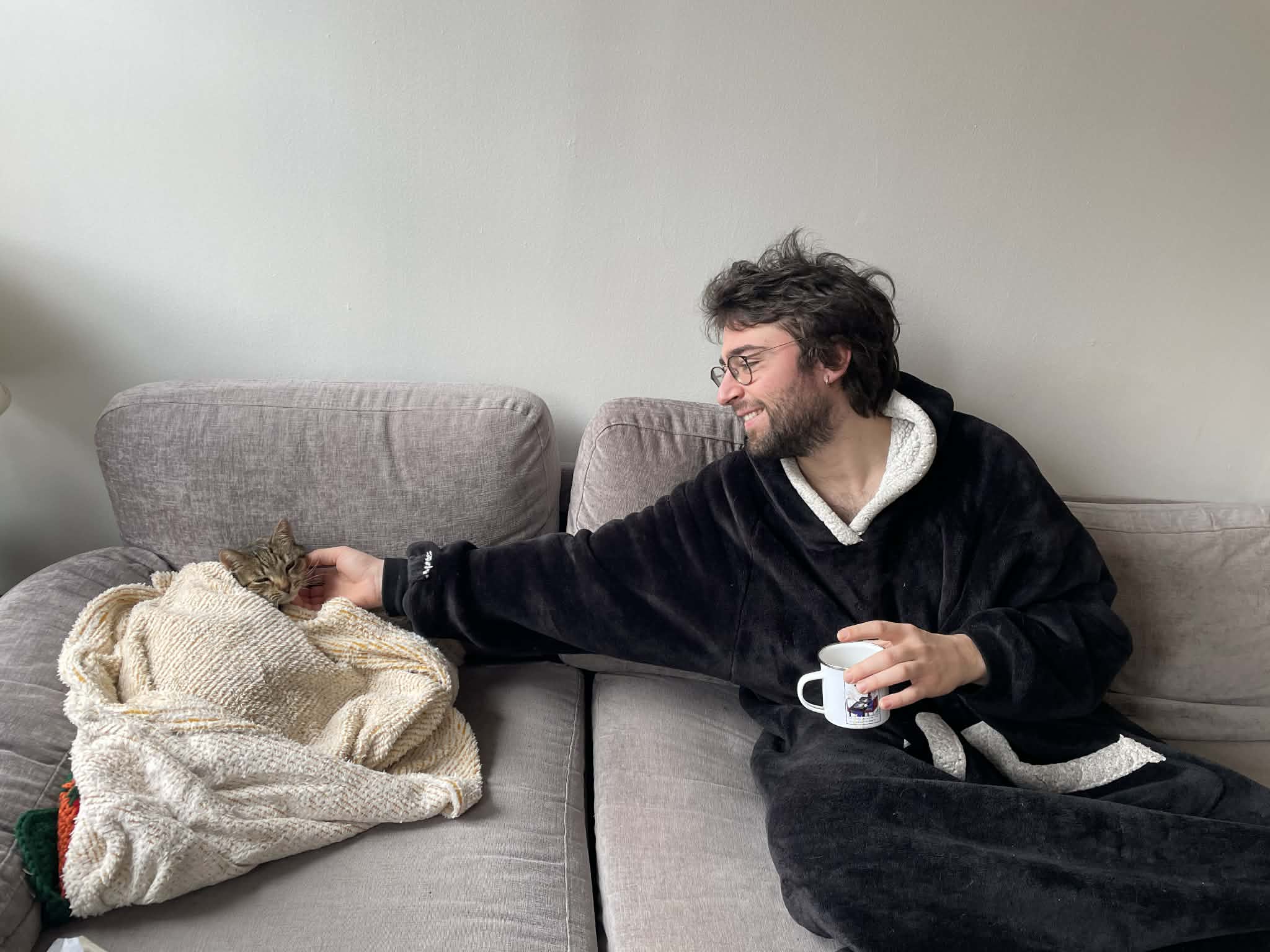
Petru Rosu (he/him) is a Romanian-born PhD candidate in Philosophy at the CUNY Graduate Center and an adjunct philosophy professor at Baruch College, CUNY. His literary work lies at the intersection of prose poetry, Borges’ “metaphysical games,” and the playful formal experiments of the Oulipians. Petru holds a B.A. in Philosophy and Mathematics from Columbia University. This is his first literary publication.