
A Love Letter to Grief
by Cindy Phan
April 12, 2026 | Non-Fiction | Moved, Touched
When I finally arrived at the hospice, my Grandma Smith was not yet dead, but she was dying.
She had been getting older and weaker over the last few years. This I knew. The grandmother I remembered from childhood, in snatches, lived alone in a charming little house on Honeycut Road, where she tended the garden and hosted Christmas every year. I thought she would live by herself in that house forever, but by the time I was in high school, she had sold it and moved into a retirement home.
Some things stayed the same. More things changed. No one hosted Christmas anymore, or if they did, I didn’t know about it. My grandma got a walker. She had to stop to take longer and longer breaks in between her sentences, and even then, her voice stayed worn and airless. Her hair thinned. She lost weight and couldn’t gain it back. She had a stroke, and then two.
The last time I saw her, she was lying flat on her back in a hospice bed, her eyes closed. Her chest rose and fell shallowly, and her skin, paper-thin, was translucent enough that I could map the topography of her every vein, purple as a bruise.
I sat down in a chair next to her bed and held her hand. People drifted in and out of the room: my Aunt Pat, my Uncle George. Someone squeezed my shoulder and whispered that they were glad I could make it. In a room where everyone was holding their breath, there wasn’t enough air to ask questions or cry. Eventually, I was ushered to the floor next to my sister, where my dad put a blanket over us. I closed my eyes and, somehow, fell asleep. It could have been one hour. It could have been five.
The next morning, my Grandma Smith was dead.
∗ ∗ ∗
By my second year of medical school, I’ve spent countless hours in scrubs and my too-big white coat, pressing my stethoscope flush against skin, kneading dimples into flesh as I palpate, percuss, and try to figure out where there is pain, where fluid has collected, where the pulse is impalpable. This, or so I’ve seen, is my role in the hospital: to discover what, if anything, is wrong, and to offer some kind of relief. I learn to ask, rote like a reflex, What brings you in today? I’m so sorry to hear that. Please, tell me more. Then, after the patient confides in me, after I poke and prod and elicit what I need, I am to say, Thank you so much for sharing that with me. I’ll pass that along to the team, and we’ll take care of you.
By taking care, I have learned to mean fix. I have learned to mean, We’ll do our best to cure you, to make you all better. But what about in moments like sitting with my grandmother, silent and still, when there is nothing for me to fix?
My Grandma Smith was old, not sick. I did not know how to bear witness to her then. In my way, I think I am hoping to prove—to myself, and to her—that I can bear witness to her now.
The act of dying, though an inevitable trajectory, is not always immediate. Hospice work is wonderful and tragic. Many of these patients are not lucid. The ones who are often embarrassed, sad, or angry. Sometimes they’re all three. A patient soils herself, and as we watch the nurse strip the bed, she tells me, “I used to be so lively. You’d never know it now, but I used to be so lively and quick. You should have known me then.”
When I look at her, she’s crying. I don’t know if she even realizes.
∗ ∗ ∗
My Grandma Smith was not my grandmother by blood, which is maybe where I should start.
My father came to Utah in 1980 as a seventeen-year-old fleeing home in the wake of the Vietnam War. The rest of his family, only able to afford passage for one, stayed behind. He bounced between foster homes, and the Smiths—a couple who left England to be closer to the Church of Jesus Christ of Latter-Day Saints, and their children, one of whom he became the youngest—were his final stop.
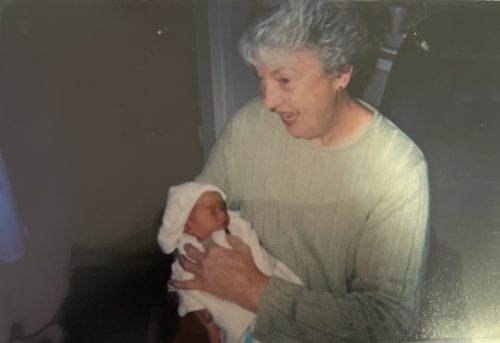
I loved my Grandma Smith for the way she loved my father and the way she tried her best to love me, too. There’s a photo of her holding me at my birth, her smiling, and me red-faced and small. But her grandchildren grew up together and knew each other like siblings, and when we would attend Christmas dinners, my family sat awkwardly on the outskirts. This was no one’s fault: my mom spoke no English, my dad never felt entitled to the space he took up, and when my sister and I were little, we were painfully, terribly shy. We brought presents for our cousins. No one knew us well enough to buy presents for us.
At these Christmas dinners, in a house that was by all metrics warm with life and laughter, I felt like nothing so much as a wistful child with my face pressed against a window, looking in at a family that was not mine.
∗ ∗ ∗
Five years after my Grandma Smith died, I came into the hospice center to see a man named Ivan sitting in the common area. I’ve seen him a couple of times before, but always in his room, the door halfway open. Today he’s dressed in nice slacks and an even nicer polo, either lovingly cared for or recently ironed.
“You look so handsome!” I tell him. “Any special occasion?”
He smiles, explains that his children and grandchildren try to visit him every other week. They last visited two weeks ago. “I wanted to dress up,” he says. “You know, in case they happen to stop by.” He’s careful with his tone, the words that he chooses: in case they happen to stop by, the pretense of deferring to chance. As if he can’t be hurt by his own want, so long as he admits to it only obliquely.
I arrive that day at around ten in the morning. Noon comes and goes, and the hours after follow steadily. Ivan stays sitting in the living room, in his nice slacks and nicer olo, as the afternoon filters into evening. Before I head out, around five or six, I sit down briefly to chat. Did they stop by? I ask. Maybe while I was upstairs?
He shakes his head, still smiling. There’s a rueful edge to it, or maybe I imagine it. “I guess today wasn’t the day,” he says, bravely. He says he knows they get busy sometimes. He says, If not today, then maybe tomorrow, or even the day after. He says it’s quite all right, that a day spent well-dressed could hardly be called a day wasted.
That night, I cried silently in the shower. About Ivan, or maybe about my Grandma Smith, who, in the years leading up to her death, I saw less and less frequently. Did she wait for me, too? Did she don her nicest clothes, or was she too weak by then to dress herself?
I think about Ivan’s family. I think about reaching out to them — and telling them what?
That I understand, maybe. That I understand the pain in watching someone you once knew fall between your fingers like sand, but that half a decade later, I am still mourning my grandmother, all those missed visits, the questions I never asked him, and the answers I never got to hear.
That if grief is love persevering, then maybe my shame, hot and burning in my throat, is some shape of grief.
∗ ∗ ∗
The hard, painful truth was that I did not know my Grandma Smith, and I knew even less how to do the work of bridging our distance. Every conversational thread I could think of was predicated on knowing the answer to another question that I had never asked, and working backwards left me frustrated, empty-handed, grasping for anything more intimate than Tell me about yourself.
In some ways, it’s easier with strangers. Our mutual anonymity means I don’t owe them familiarity, and so we can start from anywhere, even the beginning. I learn about Mary’s encounter with the Boston Strangler, Margaret’s whirlwind romance in Italy, and Rocky’s brief foray into championship boxing. Sometimes, they tell me, “I’ve never told anyone this before.” I feel ecstatic, proud. Shame follows, sour, in the next breath.
I loved my Grandma Smith. I also said no to visiting her, first only occasionally and then more and more frequently. I cited schoolwork, exhaustion, and responsibilities. The last time I saw her was when she was dying, and the time before that had been nearly a year prior.
Now, I talk to people about their conditions. The cancer that’s stolen 47 pounds from them and counting, the edema swathing their legs, the gastrointestinal hemorrhage, and the bandage that keeps needing to be changed, like clockwork.
I didn’t know how to ask my grandma how she was doing in any way that mattered. I wasn’t a medical student then. I was barely her granddaughter. Both of those things made the thought of conversation unbearable.
Once, after a stroke, she’d suffered a fall that had bruised the side of her face terribly. I remember making eye contact with her, resolutely ignoring the burst vessels and how they mottled her skin an ugly, violent purple. I didn’t ask her about the stroke, or her health, afraid that casting the spotlight on it would make it more real, and what would I have done with it then? Maybe she didn’t want to talk about it. Or maybe I didn’t know how to hear about it.
∗ ∗ ∗
Before my Grandma Smith died, I thought she was already dead.
My Aunt Pat only had my family’s landline, but she didn’t know it was a landline and so kept leaving texts that we never received, which is why we didn’t know about my grandmother’s initial hospice admission or the deterioration of her health. Somehow, one of her calls went through. My parents, in their panic and confusion, misinterpreted it.
I was in second period, IB European History, when I received a text from my mom that my grandmother was dead. I remember the numbness first. Remember raising my hand and, in a daze, ears ringing, and hearing myself ask, as if from very far away, to go to the bathroom. Remember, leaving without waiting for Mr. Krueger to answer. This is how I know I loved my grandmother, in spite of everything: I sank down in the hallway and cried so hard I couldn’t breathe, guttural sobs ripped straight from my chest, from somewhere deep and primal. Deeper than muscle, deeper than bone. My grief, as true as my shame. As true as my love.
When my father picked me up, I thought we were going to pay our respects to her dead ody. Imagine my surprise when we got there a,nd she was not yet dead. My resurging hope was a tremulous thing. She was not yet dead, but she was also not alive enough or me to make anything right. The clock turned back. Just not enough.
You know how the story goes. She doesn’t wake up. I don’t ask her anything. She dies.
∗ ∗ ∗
Here’s another way the story goes.
They thought my Grandma Smith was supposed to die a week before she did, but she didn’t die until my family came. Aunt Pat says she was waiting for us. My Grandma Smith was not alive enough to wake up, not even when we arrived, but I hope she was alive enough to know that we came. That I slept on the floor next to her. That I loved her.
so moving… my grandmother is just like her’s
my wonderbug
THIS IS SO SAD NO NO NO 😭😭💔💔 VERY BEAUTIFUL