
Ode to Frog
by Madeline Merritt
March 15, 2026 | Essay | Delighted
I’ve always been fascinated by frogs. Many of my earliest childhood memories are of catching them: chasing them by sound across dampened grass on summer nights; rooting them out from high places on the house siding; trying—and failing—to sneak up on the drainage pipe on our property where they nested (their croaks would always fall silent long before I got close); and learning—the hard way—to wash my hands after holding one, lest I rub my eyes and cause them to burn. My interest in them never waned as I aged, though our meetings did evolve: I’d find them lounging on our porch railing in the evenings, soaking up the moisture from an afternoon rain, and leave them undisturbed save for a gentle stroke of a finger down their back; rescue them from precarious places, delivering them to safety in the warmth of two cupped palms. Once I even found one stuck to my bedroom window screen after dark and used the light from my phone screen to attract it to a meal. I did all this for no other purpose than to see them up close, to simply have the chance to hold them, and to say hello, and I still do it today.
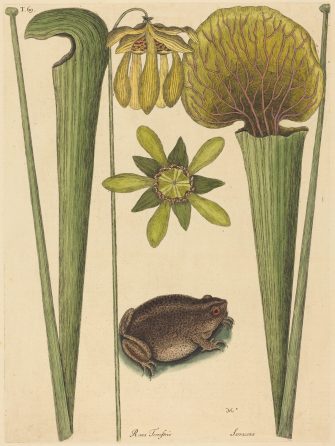
The last frog I saw came to me in August, stuck to my car window the morning after a warm rain, and I haven’t stopped thinking about it since. Our encounter lives on in my mind with a level of reverence I can’t possibly hope to describe—like a visit from some sort of mystical being you can’t understand, only bear witness to. This is not something I can explain, but frankly, I don’t feel I should have to—we’re each allowed our own favorite things in life, and I see no reason why anyone should be expected to justify theirs. If I had to pick something, though—to reduce my adoration of frogs down to a single transferable thought—it would be that frogs don’t begin as frogs at all and that their life cycle—although similar in ways to other metamorphosing animals—is also unlike any other species’ on the planet.
For starters, I use the term “metamorphosizing animals” to mean any animal that undergoes some sort of physical transformation during its lifetime, which are namely insects, crustaceans, various marine invertebrates, and amphibians. Scientifically, this is further broken down into two categories—complete and incomplete—which differ mainly in how drastically the organism changes during metamorphosis: how many times they change and how far they have to go to reach their final adult form. And in such a contest, no one does it quite like the frog (except possibly for the salamander, but this is all I’ll say about it here: they simply don’t interest me).
The first stage of a frog’s life—like all others in the metamorphosing animals list and, if you want to get technical, even our own—is an egg, laid to incubate in the stale murk of a stilled pool of water in the warmth of a new spring. But what emerges from that egg after two to three weeks is not yet a frog, but a tadpole—a legless, armless, thin-tailed blob that after a few weeks will still be no bigger than the tip of a pencil eraser. It takes them about a week to learn to use their tails for movement, another four to start growing back legs, and another seven weeks to form their front legs and head. And still, another two weeks remain before their coming-of-age is complete—with the loss of their tail, which simply drops off when it’s no longer needed. While some other animals—such as butterflies, for example—undergo complete metamorphoses of their own, what sets frogs apart from these is that the tadpole’s metamorphosis is an active transformation: it does not retreat into a chrysalis or a shell; it endures, witnessing its body warp and change day by day. It’s awake as its torso sprouts new limbs from unknown orifices and can feel the sheen of its gills glossing over as foreign lungs begin to unfurl somewhere deep and unseen. Perhaps it feels excitement, too; perhaps fear. Regardless, it bears every moment.
The other great thing about tadpoles is that they’ve been observed to exert a level of control over their metamorphosis, namely, controlling the speed at which it happens in order to enjoy favorable topside conditions earlier in the year, or the opposite—waiting out unfavorable topside conditions within the safety of the water for longer periods than normal. Though science wouldunfavorable topside have you believe this is all by Mother Nature’s hand, I think they’re selling the tadpoles short. Who’s to say that a tadpole can’t decide for itself, on its own terms, when it’s ready to change into something new? Could the allure of the unknown world above not be enough to inspire such growth? Is the sight of a sibling inching toward full metamorphosis not enough to motivate a maturation rivalry? Is the hindrance of an unusable tail upon land not enough to spark its removal by whatever means necessary? I ask you, why must we limit these beings to nothing more than instinct? Why is it so hard to believe they have the capacity for self-determination? Why can’t the frog who hitched a ride on my car be a visitor who was there just for me?
Once, I was lucky enough to witness a flock of newly matured frogs leaving their nesting puddle. It was on the shores of Lake Huron, a place I’ve visited almost twenty times across my life, but an event I’ve seen only once.
I stumbled across the puddle walking the rocky outcroppings that lined most of the shoreline, a small circle of water nestled safely in a divot that spared it from the wind and waves. I likely wouldn’t have noticed it at all if not for the fact that, as I approached it, it looked as if the rock around the puddle was moving, shifting in and out of focus, like it was coated in a layer of TV static. Upon closer inspection, though, it wasn’t the rock moving at all: it was hundreds of miniature frogs, each one smaller than a dime, with even larger hoards jumping out of the puddle by the second. As you might imagine, I felt as if I’d struck pure gold. Careful of where I shuffled my feet, I bent down and scooped up a handful of the tiny things, keeping my fingers open and my hand close to the ground in case anyone would think to jump. There must’ve been more than fifty of them sitting in my palm; who knows how many more were surrounding me.
I’ll always cherish that their first glimpse of the world above was me.
it reminded me of my childhood! when I lived in Winnipeg I loved going down to a small stream and watch the tadpoles! but now there are no tadpoles left when I visited there last summer, all abandoned
Froggiessss. This brings back so many memories of going to the Lake Mead with my family. I once tried to pick up a gigantic frog, but it lunged towards my face. Mads truly you are so talented and this is so beautifully written. This has lifted me up and make my day, heck even week even better. I wait for more stories you publicized. Love Ari ˃͈◡˂͈